How Creativity Saved Me pt.1
Have you ever tried to put pen to paper and allow your imagination to run wild—to think freely, to write without judgment?
See, when you’re a kid, your inhibitions are less restrictive—you do things just to try them. Half the time, you didn’t know if it would pan out, but there was a carefree wander that existed. A wander guided only by infinite curiosity.
Creative coaching often begins with removing pressure. Many creatives are stuck not because they lack ideas, but because they are overthinking outcomes. A coach helps you return to process over performance, shifting the focus from validation to exploration.
When fear is named and unpacked, it loses its power. The work becomes lighter, more playful, and surprisingly more productive. Creativity thrives in permission, not perfection.
And somewhere along the lines, we started to pick up the worries of the world. We were introduced to tragedy, to responsibilities, to what it means to be an “adult.” And as we get to that place, we lose that childlike wander. There’s no room to play when you have bills to pay, and you’re living check to check.
So you have to find your way back. Find your way back to the creative you once knew, to the creative you yearned for, to the creative child in you.
I’ve found that child so many times in my life, and I’m only now realizing that it was indeed that child I was finding. I’ve lived so many creative lives, and when I think back to the times I felt the most depressed, I realize those were the times I felt most distant from that inner child.
This wasn’t something I understood in the moment—it only became clear looking back.
That inner child was asking to heal, and in the only way she knew how: through creative practices. Let me tell you, she showed up so many times before I realized it was her. But we have finally arrived, and now, anytime I pick up a toy, read a book, water a plant, or go to the store and pick up a game I once played with, it’s me recognizing her and allowing her to play—only to be met with joy every single time it happens.
But it wasn’t always like that.
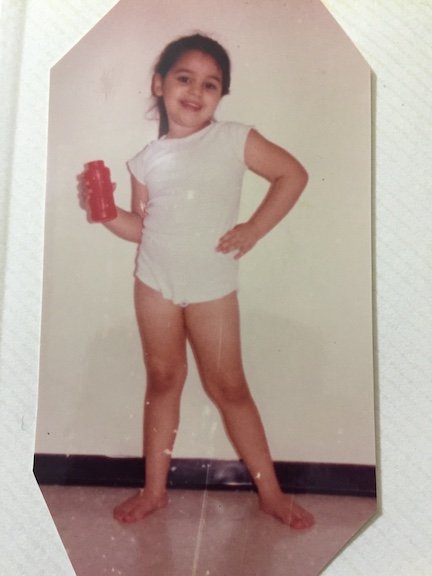
See, the kid I was growing up always played. She wrote plays and horror stories. She planned out talent shows. She drew, she danced, she sang (not great). But she didn’t care what people thought, because creating was innate to her.
That imagination halted when she started growing up, and real-world sh*t happened. Being the eldest of four and the only girl, she was introduced to “her role” in society and life. She was to be the responsible one—the caretaker when the adults were too busy working, and ultimately, the fixer of her family’s problems. All burdens she did not sign up for, but was given.
So she ran away—not in the “angst teenager hating their parents” kind of way, but in a “I got accepted to colleges upstate, so it gives me a reason” kind of way. She made the conscious decision to leave, but the subconscious decision to get away—you feel me?
At that time, I couldn’t have been further away from that inner child. I didn’t realize it then, but that distance caused a deep depression.
I was questioning everything. After three years of pursuing a degree in Computer Engineering, I felt lost. The path I had chosen wasn’t my own. It was the path I thought I was supposed to take. The only person in my family who went this route did it, so I should follow it too, right? How many of us can relate to doing something because it was chosen for you—or because it was the only path you knew?
This wouldn’t be the last time I felt this way, and it wasn’t the first—but it was a first. The first time I experienced depression where I only had myself to rely on to get me out of it, away from home. I was so distant from my own faith—more on that for a later post—that I truly felt alone, and I didn’t know how to handle it.
It was that deep sadness you can’t explain. When thoughts run rampant, and all you want to do is stay under the sheets of your own bed and hide. Every time you’re around people, you question why you are so sad—why are you like this? When dark thoughts cross your mind, and you don’t really understand why. That depression that makes laughing hurt even more, because it’s fake. It all feels fake. That kind of depression.
Looking back now, this was the moment everything began to shift—even if I didn’t know it yet.
So what did I do? How did I get out of it? I wrote poetry in the darkness of my college bedroom. I released in the only way I knew how. I had somehow tapped into my inner child—or in reality, she decided to crawl through the noise of my brain to show herself.
This was the beginning of my release.
Side note—I would have loved to imagine a sassy little Christine with a mic in her hand, her other hand on her hip, saying, “Hello, remember me.” But alas, she didn’t come through smiling and sassy. She came with pain all over her face, body, and language. Trauma and experiences she was holding onto, and often didn’t understand. I needed to find a way to release her from it—or at least start. So I did. Poetry did that for me. Better yet, words did that for me. I was always better at writing my feelings than saying them anyway. So it makes sense that my poems were heavy. I cried when I wrote them, and I cried when I read them.
Poetry gave me new insight into how I saw the world. And I knew how much I still needed to heal—but the release was cathartic enough to allow me to shift my direction.
So even when I didn’t realize it, I was creating to heal.
I was fortunate enough, during this dark period of time, to take one digital arts class—and boy, did that open my world to possibility again. Something sparked in me.
I didn’t trust it at first, but it was there. My creative expression was leading me to more…
I felt excited again. Every class, every project, every film I had to watch excited me. Long, sleepless nights didn’t matter because it was where I belonged. I finally felt like I was on the right path.
And I was—until I hit my next block. And boy, did that hit me like a ton of bricks, only to reveal there was more to heal from.
As I started to understand this in my own life, I began to notice it everywhere.
I continue to learn that when we find our way back to a creative practice and exercise it, it triggers our inner child—and that brings us joy.
For me, that realization changed everything. Because creativity didn’t just help me cope - it saved me.
And I’m still learning what it means to keep choosing it.